
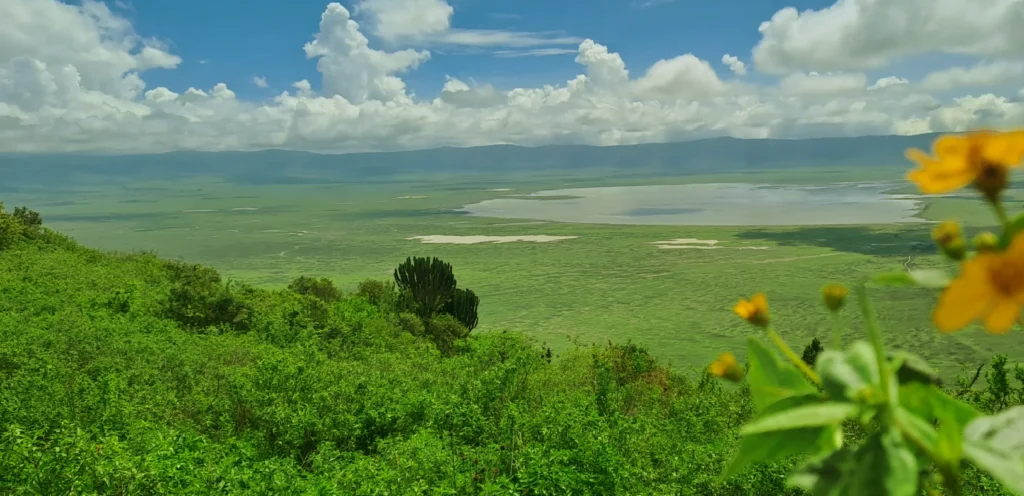
Quick answer: The Ngorongoro Crater is the world’s largest intact volcanic caldera, holding one of Africa’s densest concentrations of wildlife within its 260 square kilometre floor, including one of Tanzania’s last remaining black rhino populations. Most visitors combine it with the Serengeti and Tarangire on a northern Tanzania circuit.
Often called Africa’s Garden of Eden, the crater packs an extraordinary variety of wildlife into a single, self-contained ecosystem enclosed by walls up to 600 metres high.
Why It’s Called Africa’s Garden of Eden
Ngorongoro formed roughly two to three million years ago when a large volcano collapsed in on itself, leaving behind a caldera around 20 kilometres wide and 600 metres deep. Because the crater’s steep walls trap resident wildlife within its floor year-round, animals rarely need to migrate in or out, creating one of the most reliable, concentrated wildlife-viewing experiences anywhere in Africa. The crater rim sits at roughly 2,400 metres above sea level, while the floor drops to around 1,800 metres, so the drive down alone brings a noticeable shift in temperature and vegetation.
Wildlife in the Crater
An estimated 25,000 large animals live on the crater floor at any given time, including dense populations of lion, spotted hyena and jackal alongside grazing herds of wildebeest, zebra and buffalo. Ngorongoro also protects one of Tanzania’s last remaining black rhino populations, and the crater is one of the few places left in Africa where sightings, while not guaranteed, are genuinely possible on a single game drive. Elephants inside the crater are almost always large bulls, since the steep walls make the climb difficult for calves and family herds, which tend to stay on the surrounding highlands instead. At the centre of it all sits Lake Magadi, a shallow soda lake that draws flamingos and other water birds depending on rainfall.
The Maasai of Ngorongoro
Unlike most protected areas in East Africa, the Ngorongoro Conservation Area allows Maasai communities to continue grazing cattle within its boundaries, a unique conservation model balancing wildlife protection with traditional pastoral life. You’ll likely pass Maasai herders and their cattle on the roads leading to and from the crater, and some lodges and camps can arrange a respectful visit to a nearby community, similar to a Maasai village visit in Kenya’s Maasai Mara.
Getting Down Into the Crater
Only a handful of tracks lead down to the crater floor, and vehicles must stick to them rather than driving freely as in most parks. Most visitors descend early in the morning, spend three to five hours exploring the floor, and climb back out by early afternoon, since gate times and crater floor hours are strictly enforced to limit vehicle congestion. A private guide is essential here, both for navigating the steep descent roads and for knowing where wildlife tends to concentrate on a given day.
Where to Stay
Lodges perched on the crater rim offer some of the most dramatic views of any safari accommodation in East Africa, though nights up there can be genuinely cold given the altitude. Travellers on a tighter budget often base themselves in nearby Karatu town instead, adding a slightly longer drive to the crater rim in exchange for lower rates and a wider choice of properties.
Ngorongoro vs the Serengeti
Ngorongoro and the Serengeti are often visited back to back, but they offer different experiences. The Serengeti is vast and open, built around the great wildebeest migration, while Ngorongoro is compact, contained and almost guaranteed to deliver dense wildlife sightings in a single day, rain or dry season. Most itineraries treat a day in the crater as a highlight stop within a longer Serengeti-based safari rather than a standalone destination.
Best Time to Visit
The crater is a year-round destination since wildlife doesn’t migrate out of it. June to October and January to March offer the driest, clearest conditions and the easiest driving on the descent roads, while the November and April to May rains bring lush green scenery and fewer vehicles, at the cost of some muddy tracks.
How to Get There
Ngorongoro is typically reached by road from Arusha, around three to four hours. It is commonly combined with the Serengeti and Tarangire on a single circuit rather than visited on its own.
Frequently Asked Questions
How long should I spend at Ngorongoro?
One full day inside the crater is typical, often as part of a longer northern Tanzania safari that also covers the Serengeti and Tarangire.
Can I see the Big Five at Ngorongoro?
Yes, the crater is one of the most reliable places in Africa to see all of the Big Five in a single day. However, rhino and leopard sightings still require some luck.
Is Ngorongoro part of the Serengeti?
No, it’s a separate conservation area managed by the Ngorongoro Conservation Area Authority.
Is it cold at Ngorongoro?
The crater rim can be surprisingly cold, especially early in the morning. Pack a warm layer even though the floor below warms up quickly once the sun is up.
Plan Your Ngorongoro Safari with Esther Luxe Safaris
See our 2-Day Ngorongoro Crater Safari or our full Ngorongoro destination guide. Follow us on Instagram for recent sightings, or contact us to start planning.